Author: Shefaly Yogendra

  • Future-proofing your business

    Future-proofing your business

    In 2026, it should be an already established and widely understood fact in European boardrooms that board simulations are key to future-proofing one’s business.

    Board simulations challenge existing mental models for organisational decision-making. They help stress-test assumptions, challenge normalcy bias and groupthink, stretch imaginations, identify potential breaking points, and critically, enable the building of organisational muscle for when unexpected scenarios come to pass.

    They are, in effect, dress rehearsals for decision-making under duress. Like fire drills, they are not about predicting the next fire, but about ensuring that a fire alarm does not cause panic and everyone evacuate safely under the fire marshal’s directions.

    The operating context for European businesses is being shaped by geopolitical gyrations, transformative technologies and climate challenges, often acting in concert. Using scenarios of plausible futures, both risks and opportunities, board simulations help boards and executive leadership test and develop their decision-making muscle for “what-when”, not just “what-if”.

    Some leading European boardrooms have been thinking ahead.

    A.P. Møller – Mærsk A/S

    The Danish shipping and logistics company, A.P. Møller – Mærsk A/S (Maersk) established Maersk Training in 1978. It delivers training globally using advanced simulators to create complex operational scenarios and real-world environments. Focusing on operations however, these simulations did not envisage enterprise-wide digital collapse.

    When Maersk experienced the NotPetya cyber-attack in 2017, their entire global network went dark rapidly, wiping out port terminals, immobilising 17 of Maersk’s 76 international ports. All of the network’s domain controllers were knocked out too. This was not anticipated. Mobilising staff and external consultants, port operations were brought back online first and the rebuild of the entire global IT infrastructure took ten days, which  is a marvel of human effort and quick thinking. Full recovery took two months, with an estimated cost of $250-300 million.

    Speaking at World Economic Forum in 2018, Maersk’s Chairman Jim Hagemann Snabe admitted that Maersk was “basically average” in cybersecurity before the attack. The cyberattack and operational recovery experience changed Maersk board’s perspective of cybersecurity from a technology issue to a solvency issue. This also led to the embedding of analogue continuity into their business strategy. Maersk’s board now oversees annual “Black Swan” simulations, focusing on decision-making under ambiguity and financial escalation paths where manual overrides get initiated.

    Schneider Electric

    Since 2019, Schneider Electric has participated in and sponsored “Black Sky” simulations. EIS Council defines a “Black Sky” event as one that “disrupts the normal functioning of our critical infrastructures in multiple regions, for long durations”. An example would be a long-lasting subcontinent-wide power outage caused by a cyber-attack, high-altitude electromagnetic pulse, or extreme space weather.

    Starting with a focus on systemic Interdependency, the challenges of a supply chain collapse became obvious quickly. Schneider Electric’s 2021 & 2022 Sustainability and Universal Registration documents highlight how these simulations shaped board-level governance and decisions.

    The board recognised the vulnerability of a “smart” grid to a blackout, and initiated investment in analogue-digital hybrid capability and manual overrides. Noting the risks from just-in-time supply chains, the board also authorised a move towards the regionalisation of sourcing. Alert to the fact that a business cannot function if the community around it collapses, and hence the need for community resilience, the board decide to embed grid neutrality and microgrids into their ESG objectives.  

    Schneider Electric shifted its stance to enabling microgrid autonomy and to provisioning energy-as-a-service, allowing key services such as hospitals to operate fully off-grid using onsite solar and battery storage.

    ASML

    In a 2023 interview with NRC, a Dutch newspaper of record, former CEO Peter Wennink spoke of how the board was alert to the overuse of export controls impacting ASML’s innovation cycle. The board gamed a 5-year outlook where the loss of Chinese revenue would cause a slowdown in Next-Gen (Hyper-NA) development. The simulation led to the board adopting a more vocal public advocacy stance and regionalising their supply chain to guard against risks of over-reliance on one geopolitical corridor.

    ASML’s 2024 Investor Day materials and strategic report detail how the board examined three distinct geopolitical stress scenarios for the 2025–2030 period. The simulation provided floor level perspectives and gave confidence to the board to approve a €36B–€40B revenue target for 2026.

    As of 2025 ASML practices dynamic geopolitical monitoring and in 2026 following a simulation of a 3-player game, the board approved a review to evaluate de-Americanisation of certain non-critical supply chain components to reduce their exposure.

    The final word.

    These are but three robust examples of how board simulations are already being used in European boardrooms to anticipate plausible futures. Their scope is vast covering complex cross-overs of geopolitics, technology and climate related challenges, demonstrating strategic imagination.

    The simulations use and sharpen leadership’s ability to read big and small signals in the business environment, ignite their strategic foresight to anticipate future challenges and opportunities, and test their willingness and ability to “think the unthinkable”. Together these can enable organisational capacity and capability to adapt.

    The real question in 2026 is: what will it take to make board simulations a non-negotiable part of boardroom discipline and hygiene across all European businesses?

    This article was first published on The European Business Review on 10 May 2026.

  • Corporate governance in the age of geopolitics

    Corporate governance in the age of geopolitics

    A new operating landscape is here. If there are corporate boards that have not, as of spring 2026, recognized that geopolitics and geoeconomics have entered the boardroom and are completely overhauling the interiors, they may already be costing shareholders far more value than they create. Recent developments make this shift difficult to ignore. 

    The Chinese government has introduced new regulations on industrial and supply chain security, explicitly framing supply chain production as a matter of national security. Investigations can reportedly be launched into actions deemed to endanger the country’s industrial stability, with countermeasures, including bans and restrictions, applied to any foreign entities or international organizations. This points to a wider trend: supply chains are increasingly evolving from commercial systems to instruments of state power.   

    The French government has announced plans to move away from Windows to Linux, potentially reshaping the competitive landscape for software operators, even as structural dependencies, such as reliance on non-European hardware, underscore the limits of rapid technological sovereignty. It has also been widely reported that oil tankers transiting the Strait of Hormuz have been paying passage in yuan, challenging long-standing assumptions about dollar dominance in global energy markets, a symbolic but closely watched development in the gradual diversification of settlement currencies. 

    Appearing in front of the Senate Banking Committee on April 21, Kevin Warsh noted: “There are risks to the U.S. position in the world, including economic.” He pointed to the importance of a coordinated statecraft agenda. Shortly thereafter, Treasury Secretary Scott Bessent indicated that the UAE and several Gulf and Asian economies had requested dollar swap lines from the U.S., a reminder that, even amid diversification pressures, global demand for dollar liquidity remains structurally embedded. 

    From The End of History and the Last Man in 1992 to The World is Flat in 2005, a generation of thinking about unfettered free markets shaped corporate governance, often assuming a minimal role for the state. In 2026, however, the World Bank released “Industrial Policy for Development: Approaches in the 21st Century,” with its chief economist conceding that its earlier stance “has not aged well,” signaling that the state is no longer a peripheral actor in markets but a central architect. 

    It is a truism in geopolitics that nation-state interests are permanent, while alliances are transient. National mandates and ambitions are increasingly determining the definition of prosperity, which is a role corporations once largely occupied on their own.

    How should boards respond?

    The board’s mindset needs to change—because the operating model already has. If more nations adopt restrictive and potentially punitive supply chain and national security policies, the prevailing model of corporate governance will need to rapidly move from “market-first” to “security-aware,” if not, in some sectors, explicitly “security-first.”  

    For large multinational corporations operating across jurisdictions, governance structures and oversight models will require meaningful redesign. The relationship between parent and subsidiary boards is likely to come under strain, necessitating a rebalancing of decision-making authority. Boards will need to reassess location strategy in light of political risk, compliance burdens and their embedded costs, the permanence of trade policy as a cost of doing business, mechanisms for moving capital across jurisdictions amid sanctions and restrictions and the viability of alternative payment systems and settlement rails. Some decisions will be best made by subsidiary boards, and others will remain with the primary board. In practice, this means some decisions will migrate closer to local markets, while others remain centralized, creating a more dynamic and, at times, contested governance model. 

    For smaller corporations and traders, supply chain disruption may be existential. Business economics can change based on rapid volatility in energy prices, raw materials, tariffs and sanctions. Where such firms have boards, directors may need to engage more directly in operational realities than traditional norms would suggest, blurring the line between oversight and active strategic participation. 

    Regardless of company size, board composition will need to evolve. Directors must be geo-literate: capable of monitoring geopolitical developments, interpreting geoeconomic signals and preparing for sustained periods of strategic friction between major powers. In aggregate, these shifts will catalyze changes in governance practice, oversight and decision-making. Cognitive flexibility, paired with informed judgment, will become a vital cornerstone of effective boards in this environment. 

    The board’s responsibility is to ensure long-term stewardship of capital and resources. When States are changing the rules of the game, strategy-setting must get comfortable with much larger power plays beyond the bounds of the corporation itself. 

    The board’s responsibility remains the long-term stewardship of capital and resources. But when states are actively rewriting the rules of the game, strategy-setting must contend with forces well beyond the firm’s immediate control. In this environment, boards cannot rely on unexamined assumptions or narrow perspectives. Nor can they simply align with the dominant power center of the moment—that may prove neither durable nor scalable. Strategic clarity and operational flexibility are now foundational to the board agenda. Paradoxically, periods of instability often offer the best conditions for building institutional resilience and long-term capability. 

    Some strategic choices will necessarily be short-term, reflecting the fluid nature of international relationships. Constraints will emerge, but then again, so will opportunities. For example, JPMorgan has launched a 10-year security and resilience initiative aimed at mobilizing $1.5 trillion for companies in Europe and the U.K. across sectors deemed critical to national security, including energy, infrastructure, quantum computing and A.I. This indicates a broader alignment of capital allocation with geopolitical priorities.  

    Media narratives may often shape perception, but deeper data can tell a more nuanced story. While some energy transactions may be settling in yuan and the U.S. dollar’s share of global reserves has declined from 71 percent to 59 percent since the 1990s, capital flows into U.S. equities over the past 15 years mean that half of global stock market wealth remains tied to U.S. markets. Boards must learn to navigate these apparent contradictions, recognizing both diversification trends and enduring structural strengths. 

    At a recent private markets conference in London, a leading American private equity partner and investor in the energy transition remarked that he has never felt better as an investor, as the market feels “more rational.” Global energy transition investment totaled $2.3 trillion in 2025. In 2026, it has continued to accelerate as the conflict in West Asia encourages reduced reliance on petrol and diesel, and the growth of electrification. 

    Electric vehicles, with fewer moving parts than internal combustion engine vehicles, may play a role in reshaping manufacturing strategies, particularly in the context of “friend-shoring,” “near-shoring” and onshoring. Yet execution risk remains significant, often less about capital availability and more about infrastructure readiness, such as grid capacity. Delays in these systems can cascade, affecting timelines and returns across entire investment theses. Regardless of ideological stance, boards must engage with realpolitik in a nuanced way, identifying both risks and emerging opportunities as they crystallize. 

    The final word

    Governance is a contact sport. Boards and business leaders running a marathon made up of several relay races, and the current phase is defined by industrial statecraft, competing spheres of influence and shifting power dynamics. 

    Amid rapid change, the core role of the boards stays the same: to make choices. Free markets have always been about the freedom to choose, within limits. Today, those limits are simply being defined by the state. How organizations play within them, and where they choose to push against them, will define the next era of corporate performance. 

    This article first appeared in the Expert Insights section of Observer on 5 May 2026.

  • Need for future-relevant governance

    Need for future-relevant governance

    “The next trillion-dollar company will likely have five employees”. This was said at a recently concluded thought leadership forum. This would be made possible by the wider adoption of Artificial Intelligence (AI) and other technologies that can empower small, even non-collocated, teams to build new products and services with far fewer resources with AI agents assisting and enhancing workflows, and sometimes running them end to end, with or without a human in the loop.

    In other words, we are in uncharted spaces where technology-enabled micro-entrepreneurship will become the engine of economic growth.

    These micro-enterprises, with sizeable valuations, will require new, future-relevant governance; the structures, methods, and people currently shaping the strategic direction and holding leaders accountable for their decisions may not fit the bill.

    Future-relevant governance will operate differently, allocating more time to strategic foresight and innovation, and less to compliance and box-ticking. The board will ask questions about whom these trillion-dollar companies are serving and how, what risks yet unseen may be created and will need mitigation, and what kind of investors might get on board to finance the wealth creation being promised. Indeed when “trillion-dollar” is held up as a marker of success, the language is still signalling old metrics and measures of success, better suited to current corporate forms. With its job of ensuring the long-term success of the micro-enterprise, the board must ask: How financially and socially sustainable is a micro-enterprise that replaces humans with agents and tokens?

    When decisions in a company are jointly made by agents and humans, how would the conversation about accountability change? In 2022, Air Canada’s chatbot gave a passenger misleading advice. The company tried to argue that the chatbot is a”separate legal entity that is responsible for its own actions”. The judge did not buy the argument. But when a technology vendor pushing the possibilities of their constantly evolving tool, a workflow of a company, and a human in the loop are all involved in every decision, how might a judge see a customer dispute in the courts of law? What happens when an agent goes rogue, as we sometimes see reported? What unforeseeable risks may be created? Governance related questions in such a context will have to change dramatically.

    A decentralised organisation, whether selling services or physical goods, will need different, fail-safe guardrails to protect its core work and its operating backbone, and to build resilience into its core. Future-relevant governance will demand greater executive competence in matters of supply chain resilience and backup plans.

    The term fintech is used to refer to nimble companies creating and applyinginnovative technologies to products and services in the financial industry. But they are still regulated like any other purveyor of financial products and services.When companies run by a mix of a small number of humans, with automated agentic workflows, emerge, they may solve wholly unforeseen problems in new ways. This will redefine several traditional ideas. When the boundaries between sectors are already dissolving, how will we define competition? How will we collaborate between companies without it being seen as anti-competitive? As we move away from old definitions and paradigms, governance will need to evolve to balance opportunities and risks even as the business environment itself evolves.

    All this will create interesting conundrums for regulation and companies interacting with regulators. If boundaries of sectors and companies change, existing regulatory structures may not remain relevant.New regulators, regulatory framework, and regulatory practices may indeed be needed. A nation-State’s governance structure will need to be up for the job of tackling this change and uncharted territory.

    Given the complexity, future-relevant governance will need a bigger range of skills, capabilities, temperaments, and personalities to do the job right. Will the board members of such a micro-enterprise out-number the employees?

    For a vibrant democracy with a large young population such as India, the micro-enterprise of the future puts one topic front and centre: How do skilling and education of upcoming generations need to change? This is the first question that future-relevant governance needs to address urgently, so that the trillion-dollar micro-enterprise can be created.

    This article was first published in the Hindustan Times on 1 May 2026.

  • The Instagram Live

    The Instagram Live

    Most of my adult life has been lived navigating multiple timezones, with friends and family in other countries. Kickstarting the global launch of my (first) book was not going to be any different. I have delivered plenty of virtual talks and speeches but I I had never done an Instagram Live. No time like the present.

    Launch Day therefore began with an 8am BST Instagram Live, with Naina, who has begun her own adventure into Uncharted Spaces with a move to Australia. London and Adelaide. In a live conversation enabled by the web.

    To be fair, Naina is the OG of many Uncharted Spaces, including being the first Indian on Twitter and possibly the first luxury photographer in India.

    She has written her account of our conversation and the full conversation is available on YouTube and Spotify.

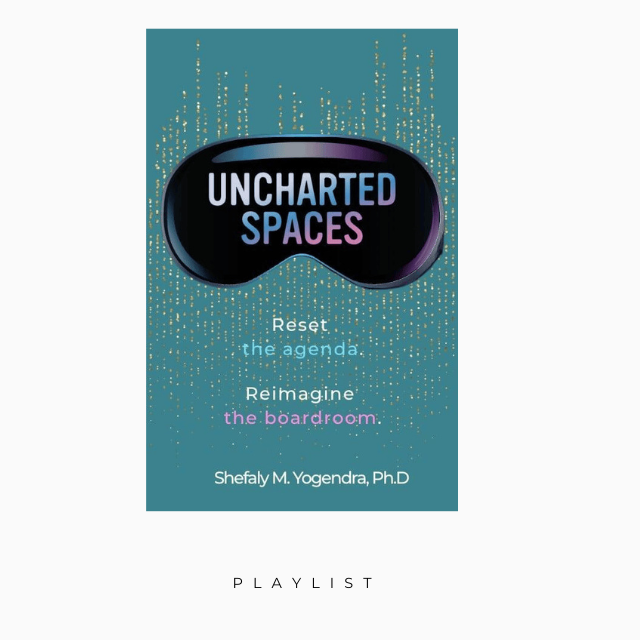
    We began with exploring the VR glasses on the cover of Uncharted Spaces. They are there quite simply to remind us to look, to observe without feeling the pressure to react.

    We discussed why I wrote the book, what boards do, how jurisdictions vary in their methods and demands, and several ideas such as metacognition, value creation in networks, epistemic crisis and its real risks, and finally, why this book has relevance not just for large companies but also solopreneurs like Naina.

    This was a special way to begin the book launch day, and I felt my return to Instagram has been worth it. With another first-time experience for me.

  • The Podcast

    The Podcast

    It is hard to frame this as cause-and-effect but I read pretty fast and have little patience for serial-access formats such as podcasts. Indeed several years ago BC (before Covid), someone asked in a group: What will make you listen to a podcast? My response was: A transcript.

    Things have changed since then.

    Most podcasts now have auto-generated transcripts and I have appeared on several podcasts myself as a guest. But choosing to listen to podcasts remains more or less an uncharted space for me.

    Then I discovered that as part of the promotional merry-go-round for their film The Rip, Ben Affleck and Matt Damon were going to be on Joe Rogan’s podcast. As someone not-young and not-male, I am definitely not Joe Rogan’s core audience. But Ben and Matt are artists of my generation and Jay and Silent Bob notwithstanding, Good Will Hunting remains a most affecting film they made together.

    In the meantime Ben Affleck Smoking memes have proliferated on the web, he has debated Bill Maher and Sam Harris on radical Islam, and while other video evidence of his fluency in Spanish exists, his character in The Rip allows him to be bilingual in Spanish and English.

    Matt Damon as Jason Bourne meanwhile has rewritten the idea of a dangerous assassin, a reference to which (and to Hunter S. Thompson) appears at the start of the Joe Rogan episode.

    It is a wide-ranging conversation. The creative process and how it is being shaped by the change in how films are now watched – not in the big screen of the cinema hall but on streaming services and small devices, with smaller attention spans, multitasking, and the ability to switch over if something does not grab you in the first few moments; the art of film making and how AI may affect it, albeit in limited ways, they argue, as the actor’s performance draws upon human lived experience; the economics of streaming services; their playbook for negotiating performance-based bonuses for the film crew; cancel culture and public shaming.

    They are both great story tellers, bringing profound and hilarious anecdotes to make their points, and turning their memetic awareness into apt comments such as Matt Damon exclaiming: “we are communists, Joe, we are from Cambridge!”

    While Charles Darwin, polymathic genius, descended from abolitionists, albeit cousin to a eugenicist, remains my ideal dinner guest, I think if Ben and Matt wanted some ace goat biryani, I would be happy to invite them over.

    Meanwhile I am happy to report that another uncharted space has been charted — Joe Rogan’s podcast.

    After all there is a life beyond the book, and uncharted spaces are all we have ahead.

  • Keep on walking

    Keep on walking

    Writing Uncharted Spaces was the most fun part of the past year. Even more fun was that I could bring all of my self to it. My background and upbringing, my interest in languages, my curiosity about cultures and their similarities and differences, my penchant for injecting humour and cultural references into the mundane to make it pop and stick in the audiences’ recall, and my professional side that thrives in challenge and enjoys horizon scanning and tech stuff for fun.

    As a result, the book features insights garnered from board directors and CEOs around the world.

    Advance readers, in their early 20s to those in their 70s, in the west and in the Global South, have moved me by sharing what they saw in the book.

    The references are in several languages, sometimes with human help with accurate translations. One reference features a parrot. “A first“, said my publisher. “For me too”, I responded.

    But most of all I have enjoyed digging into ancient Indian texts for wisdom that remains relevant to leaders in boardrooms and in the broader world in the present day.

    In my day-to-day life I often quote poetry and aphorisms. One of my favourites:

    आस्ते भग आसीनस्योर्ध्वस्तिष्ठति तिष्ठतः 

    शेते निपद्यमानस्य चराति चरतो भगश्चरैवेति

    चरैवेति चरैवेति!

    (If one’s sitting, his/ her destiny remains similarly sitting; for the one who rises, his/ her destiny does too; when one remains asleep, his/ her destiny remains asleep too; but when one starts walking, one’s destiny starts to move too. Ergo, keep walking.)

    It embodies the theme for 2026: movement. Not stasis. Not sleeping on things willy nilly. Not over-thinking. Movement. Physical, mental, spiritual.

    Befits the year: the year of the horse that starts in February 2026, the year when the book takes wings and lands in bookstores and on your shelves.

    (Credits: Mahatma Gandhi’s image from Vecteezy; Johnnie Walker is a registered trademark of Diageo.)

  • The Playlist

    The Playlist

    Some years ago, a dear friend visited with her husband and her children, who were 11 and 9 then. The parents were debating something: one parent was insisting that children should have only the best things, whereas the other was saying that if they do not occasionally eat bad food or experience rubbish quality, they will never learn to discern good from bad.

    The children were immensely fond of hot chocolate. So every day I made them some hot chocolate. I serve hot chocolate in small espresso cups which contain enough, and encourage slow savouring of the drink. They were served three hot chocolate drinks over three days — a mass market brand hot chocolate, a mid range but moreish Florentine hot chocolate, and then hot chocolate made straight from couverture.

    After that blind test, I asked them to rank their preferences. The children conferred and unanimously pronounced the one made with the couverture the best, followed by the Florentine hot chocolate. They were unimpressed with the mass market one – heavy on sugar and lecithin, low on cocoa.

    Considering their ages, this assessment and their discernment was doubly impressive.

    I thought about that visit and that exercise in developing discernment as I set out to write my book this year.

    𝘊𝘢𝘯 𝘰𝘯𝘦 𝘸𝘳𝘪𝘵𝘦 𝘢 𝘣𝘰𝘰𝘬 𝘢𝘣𝘰𝘶𝘵 𝘜𝘯𝘤𝘩𝘢𝘳𝘵𝘦𝘥 𝘚𝘱𝘢𝘤𝘦𝘴 𝘸𝘪𝘵𝘩𝘰𝘶𝘵 𝘤𝘩𝘢𝘳𝘵𝘪𝘯𝘨 𝘴𝘶𝘤𝘩 𝘴𝘱𝘢𝘤𝘦𝘴 𝘰𝘯𝘦𝘴𝘦𝘭𝘧? 𝘊𝘢𝘯 𝘰𝘯𝘦 𝘸𝘳𝘪𝘵𝘦 𝘴𝘶𝘤𝘩 𝘢 𝘣𝘰𝘰𝘬 𝘧𝘳𝘰𝘮 𝘢 𝘱𝘭𝘢𝘤𝘦 𝘰𝘧 𝘤𝘰𝘮𝘧𝘰𝘳𝘵, 𝘢𝘯𝘥 𝘴𝘢𝘧𝘦𝘵𝘺 𝘢𝘯𝘥 𝘦𝘢𝘴𝘦 𝘰𝘧 𝘰𝘭𝘥, 𝘸𝘰𝘳𝘯 𝘴𝘭𝘪𝘱𝘱𝘦𝘳𝘴? 𝘏𝘰𝘸 𝘸𝘰𝘶𝘭𝘥 𝘰𝘯𝘦 𝘬𝘯𝘰𝘸 𝘤𝘰𝘮𝘧𝘰𝘳𝘵 𝘪𝘧 𝘰𝘯𝘦 𝘩𝘢𝘴 𝘯𝘦𝘷𝘦𝘳 𝘵𝘳𝘶𝘭𝘺 𝘬𝘯𝘰𝘸𝘯 𝘥𝘪𝘴𝘤𝘰𝘮𝘧𝘰𝘳𝘵? 𝘏𝘰𝘸 𝘸𝘰𝘶𝘭𝘥 𝘰𝘯𝘦 𝘣𝘦 𝘤𝘶𝘳𝘪𝘰𝘶𝘴 𝘢𝘯𝘥 𝘦𝘹𝘱𝘦𝘳𝘪𝘮𝘦𝘯𝘵𝘢𝘭, 𝘪𝘧 𝘰𝘯𝘦 𝘩𝘢𝘴 𝘢𝘭𝘸𝘢𝘺𝘴 𝘵𝘳𝘰𝘥𝘥𝘦𝘯 𝘵𝘩𝘦 𝘣𝘦𝘢𝘵𝘦𝘯 𝘱𝘢𝘵𝘩?

    My book 𝗨𝗻𝗰𝗵𝗮𝗿𝘁𝗲𝗱 𝗦𝗽𝗮𝗰𝗲𝘀. 𝗥𝗲𝘀𝗲𝘁 𝘁𝗵𝗲 𝗔𝗴𝗲𝗻𝗱𝗮. 𝗥𝗲𝗶𝗺𝗮𝗴𝗶𝗻𝗲 𝘁𝗵𝗲 𝗕𝗼𝗮𝗿𝗱𝗿𝗼𝗼𝗺., which will be in your hands in April 2026, has indeed been born of taking that untrodden path.

    𝗣𝗿𝗼𝗳𝗲𝘀𝘀𝗶𝗼𝗻𝗮𝗹𝗹𝘆 there were several such experiences this year alone.

    I was asked to become SID to the incoming chair Charles Cade on Temple Bar Investment Trust; I am now the last remaining director with a clear memory of the fund manager change that the board undertook in the first lockdown in 2020. This professional development capped 2025.

    Being on the board of a listed company in a novel asset class, and being in the thick of things as the company experienced a bidding war over it was another professional Uncharted Space experience for me. The transaction concluded in mid-2025. With a bang, not a whimper, TS Eliot may take note. The book includes the story of Harmony Energy Income Trust — from its beginnings, its IPO, all the way to its acquisition and subsequent delisting.

    The year had begun with an appointment as an external director of Ampa Group, the world’s largest professional services B-Corp. “Bigger, better, braver” encapsulates how the firm operates, under the leadership of Sarah Walker-Smith, recognised amongst the top-20 CEOs in the UK. New sector, new ownership structure, new sector challenges of growth, financing, and AI.

    In the Directors’ Book Club that I have run for 4 years, I included two completely different 𝘧𝘪𝘤𝘵𝘪𝘰𝘯 picks: Service by John Tottenham and Trust by Hernan Diaz. Not the usual fare for professional book clubs.

    𝗣𝗲𝗿𝘀𝗼𝗻𝗮𝗹𝗹𝘆 — I rediscovered music. I come from a family with immense musical talent, grew up listening to music, and despite having more talented singers around, had a habit of singing aloud while doing chores. But I am a BBC Radio 4 type of person, and a poetry and lyrics fiend which means I am quite aware of words I am singing or listening to.

    Resuming listening to music this year I consciously moved away from focusing on lyrics, to the visceral quality of tune and beat.

    As a result the list of the top few has some surprising music artists. Here it is!

    As we step into a new year, I would love to hear what Uncharted Spaces 𝘺𝘰𝘶 intend to explore in 2026. And what music will be accompanying you there.

  • Feeling like Cassandra

    Feeling like Cassandra

    All this week I have been feeling like Cassandra.

    Speaking on the AI panel at the Criticaleye Leadership retreat on last Friday, I said a few things.

    𝘛𝘩𝘢𝘵 𝘵𝘩𝘦 𝘜𝘒’𝘴 𝘈𝘐 𝘥𝘦𝘱𝘭𝘰𝘺𝘮𝘦𝘯𝘵 𝘪𝘴 𝘵𝘰𝘰 𝘥𝘦𝘱𝘦𝘯𝘥𝘦𝘯𝘵 𝘰𝘯 𝘜𝘚𝘈 𝘱𝘳𝘰𝘷𝘪𝘥𝘦𝘳𝘴 𝘰𝘧 𝘤𝘭𝘰𝘶𝘥, 𝘮𝘰𝘥𝘦𝘭𝘴, 𝘥𝘢𝘵𝘢.

    𝘛𝘩𝘢𝘵 𝘰𝘶𝘳 𝘥𝘦𝘱𝘭𝘰𝘺𝘮𝘦𝘯𝘵𝘴 𝘤𝘰𝘶𝘭𝘥 𝘣𝘦 𝘥𝘦𝘴𝘵𝘳𝘰𝘺𝘦𝘥 𝘪𝘧, 𝘢𝘮𝘪𝘥 𝘤𝘩𝘢𝘯𝘨𝘪𝘯𝘨 𝘵𝘢𝘳𝘪𝘧𝘧𝘴 𝘦𝘵𝘤, 𝘵𝘩𝘦 𝘗𝘳𝘦𝘴𝘪𝘥𝘦𝘯𝘵 𝘰𝘧 𝘵𝘩𝘦 𝘜𝘯𝘪𝘵𝘦𝘥 𝘚𝘵𝘢𝘵𝘦𝘴 𝘢𝘴𝘬𝘴 𝘔𝘪𝘤𝘳𝘰𝘴𝘰𝘧𝘵 𝘵𝘰 𝘳𝘢𝘪𝘴𝘦 𝘵𝘩𝘦𝘪𝘳 𝘧𝘰𝘳𝘦𝘪𝘨𝘯 𝘱𝘳𝘪𝘤𝘦𝘴 𝘣𝘺 100%.

    𝘓𝘢𝘴𝘵 𝘣𝘶𝘵 𝘯𝘰𝘵 𝘵𝘩𝘦 𝘭𝘦𝘢𝘴𝘵, 𝘮𝘺 𝘧𝘪𝘳𝘴𝘵 𝘥𝘦𝘨𝘳𝘦𝘦 𝘪𝘴 𝘪𝘯 𝘦𝘯𝘨𝘪𝘯𝘦𝘦𝘳𝘪𝘯𝘨. 𝘐 𝘸𝘰𝘶𝘭𝘥 𝘣𝘦 𝘥𝘰𝘪𝘯𝘨 𝘪𝘵 𝘢 𝘥𝘪𝘴𝘴𝘦𝘳𝘷𝘪𝘤𝘦 𝘪𝘧 𝘐 𝘥𝘪𝘥 𝘯𝘰𝘵 𝘱𝘰𝘪𝘯𝘵 𝘰𝘶𝘵 𝘧𝘦𝘦𝘥𝘣𝘢𝘤𝘬 𝘭𝘰𝘰𝘱𝘴 𝘪𝘯 𝘵𝘩𝘦 𝘸𝘢𝘺 𝘸𝘦 𝘢𝘳𝘦 𝘵𝘩𝘪𝘯𝘬𝘪𝘯𝘨 𝘢𝘣𝘰𝘶𝘵 𝘈𝘐, 𝘢𝘯𝘥 𝘴𝘦𝘤𝘰𝘯𝘥 𝘢𝘯𝘥 𝘵𝘩𝘪𝘳𝘥 𝘰𝘳𝘥𝘦𝘳 𝘪𝘮𝘱𝘢𝘤𝘵𝘴 𝘰𝘧 𝘰𝘶𝘳 𝘤𝘩𝘰𝘪𝘤𝘦𝘴.

    Why am I feeling like Cassandra?

    𝘔𝘰𝘯𝘥𝘢𝘺 𝘵𝘩𝘢𝘵 𝘧𝘰𝘭𝘭𝘰𝘸𝘦𝘥: 𝘈𝘞𝘚 𝘨𝘰𝘦𝘴 𝘥𝘰𝘸𝘯 𝘵𝘢𝘬𝘪𝘯𝘨 𝘸𝘪𝘵𝘩 𝘪𝘵 𝘴𝘦𝘷𝘦𝘳𝘢𝘭 𝘜𝘒 𝘣𝘢𝘯𝘬𝘴 𝘢𝘯𝘥 𝘪𝘳𝘰𝘯𝘪𝘤𝘢𝘭𝘭𝘺 — 𝘢𝘯𝘥 𝘢𝘭𝘮𝘰𝘴𝘵 𝘢𝘴 𝘢 𝘱𝘦𝘳𝘧𝘦𝘤𝘵 𝘪𝘭𝘭𝘶𝘴𝘵𝘳𝘢𝘵𝘪𝘰𝘯 — 𝘵𝘩𝘦 𝘜𝘒 𝘨𝘰𝘷𝘦𝘳𝘯𝘮𝘦𝘯𝘵’𝘴 𝘖𝘯𝘦 𝘓𝘰𝘨𝘪𝘯 𝘥𝘪𝘨𝘪𝘵𝘢𝘭 𝘐𝘋 𝘴𝘺𝘴𝘵𝘦𝘮.

    𝘞𝘦𝘥𝘯𝘦𝘴𝘥𝘢𝘺 𝘵𝘩𝘢𝘵 𝘧𝘰𝘭𝘭𝘰𝘸𝘦𝘥 𝘵𝘩𝘦 𝘔𝘰𝘯𝘥𝘢𝘺: 𝘚𝘰𝘶𝘳𝘤𝘦𝘴 𝘴𝘢𝘺 𝘤𝘶𝘳𝘣𝘴 𝘰𝘯 𝘦𝘹𝘱𝘰𝘳𝘵𝘴 𝘵𝘰 𝘊𝘩𝘪𝘯𝘢, 𝘰𝘧 𝘵𝘩𝘪𝘯𝘨𝘴 𝘮𝘢𝘥𝘦 𝘸𝘪𝘵𝘩 𝘜𝘚𝘈 𝘴𝘰𝘧𝘵𝘸𝘢𝘳𝘦, 𝘢𝘳𝘦 𝘣𝘦𝘪𝘯𝘨 𝘤𝘰𝘯𝘴𝘪𝘥𝘦𝘳𝘦𝘥. 𝘛𝘰𝘥𝘢𝘺 𝘪𝘵 𝘪𝘴 𝘊𝘩𝘪𝘯𝘢, 𝘸𝘩𝘰 𝘬𝘯𝘰𝘸𝘴 𝘸𝘩𝘢𝘵 𝘵𝘰𝘮𝘰𝘳𝘳𝘰𝘸 𝘣𝘳𝘪𝘯𝘨𝘴.

    In these Uncharted Spaces, we are navigating much uncertainty and complexity. Ensuring organisational resilience requires vigilance. And the right kind of annoying questions from boards. Especially heed your resident Cassandra, if you have one.

  • Between the human and her computer

    Between the human and her computer

    Kathryn Bishop, CBE, who has co-authored* “Board Talk” with Gillian Camm, recently shared an experience. In doing some research she asked ChatGPT a question and the tool responded with “Excellent question!” It felt patronising, she said.

    Her post reminded me of a delightful book titled “Um…” that Michael Erard wrote almost 20 years ago. I still have it. Amazon tells me I bought it in 2007 and I had reviewed it then as a lovely book for the pedant in some or more of us. He speaks of disfluencies and explores the meaning of other verbal tics.

    I can however relate to Kathryn’s finding “excellent question” a bit patronising especially since the interaction seems personal between oneself and the computer screen. I have certainly rolled my eyes about the recorded message “please accept my apology“, always in a woman’s voice too, on my train station tannoy for delayed or cancelled trains. “I do not want a damned apology from a recording“, I grumble to nobody in particular. On the other hand, when one of the two gents, who work at the station ticket counter, makes the announcement, I feel better about the same cancellation or delay. A human told me, his apology seemed genuine, and sometimes the tone of his voice may even feel like he shares our frustration as passengers.

    Another book came to mind — “Everybody Lies” by Seth Stephens-Davidowitz. It draws upon the intimacy many web users feel with their computers, and in that intimate space, they ask some pretty interesting questions. I highly recommend that book. I cite things from it to annoy people or to amuse people at the rare dinner parties, where people still talk about books.

    Then again we hear the phrase “excellent question” in our board meetings too. And as the human colleague, who says it, is sitting across us, we can observe their body language and their playing with their pen or their shifting in their chair, and we know that the phrase is a conversational place-holder and buys them time to arrange their thoughts before they verbalise them.

    This liminal space, where machines are becoming ubiquitous in our lives but where our human OS has not changed sufficiently for us to not react emotionally to the machine’s “behaviour”, is quite fascinating.

    For these are the kinds of Uncharted Spaces we are all navigating together. Unpacking them can make us feel less alone and more connected to other humans.

    In the comments on Kathryn’s post, my friend Sarah Langslow, who is the author** of “Do Sweat the Small Stuff“, says she feels the output from an LLM tool is better if she is polite. She would say that, of course. She is English. The English are the model of politeness.

    But a Penn State short research paper finds it works better if you are rude in your tone.

    We truly are in Uncharted Spaces but it is in our power to determine where we all choose to go. Human First, I’d posit, is the way forward.


    *Board Talk is available at all good bookstores and is published by Practical Inspiration Publishing, also my publisher.

    ** Do Sweat the Small Stuff is also published by Practical Inspiration Publishing, and is available at all good bookstores.